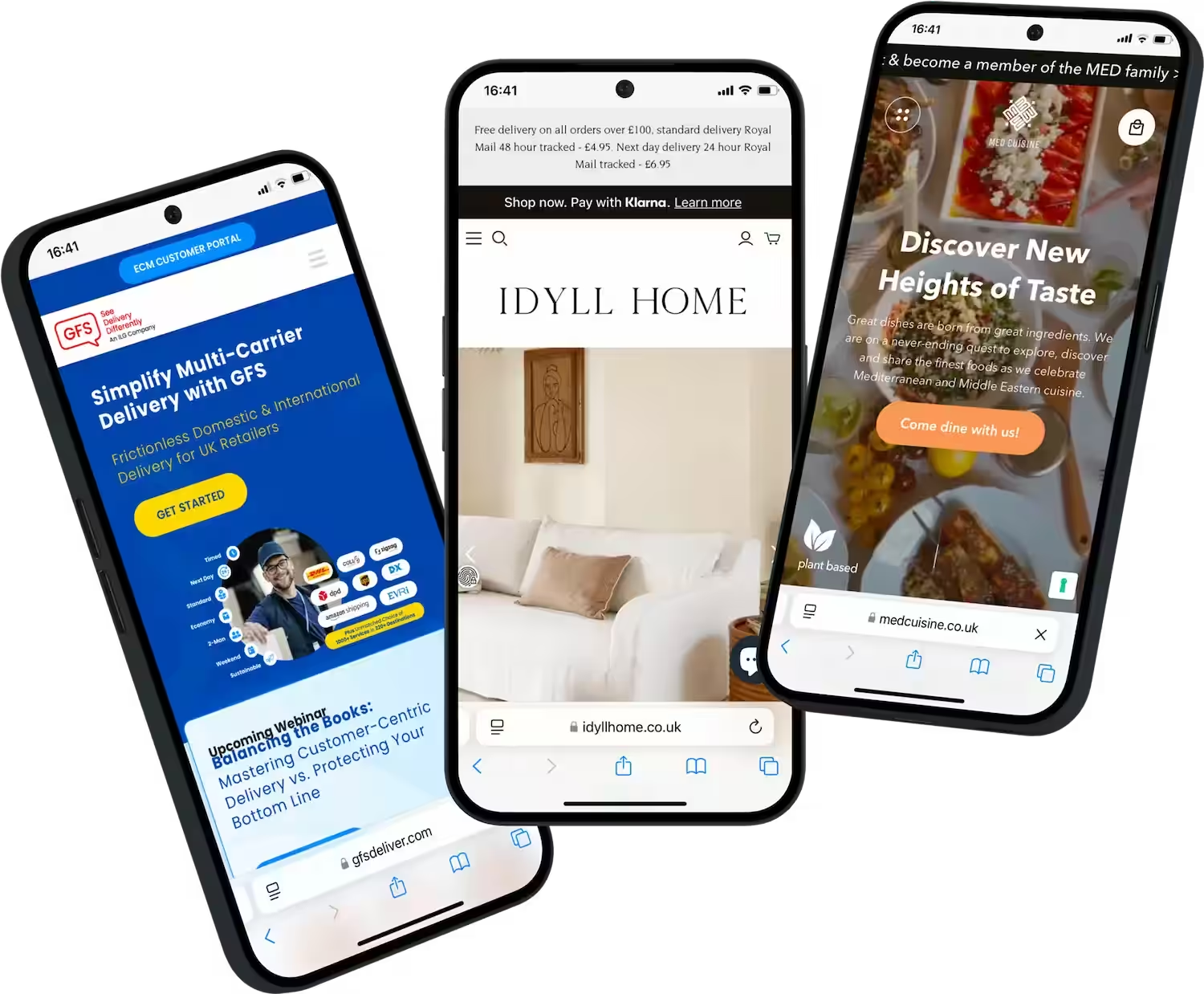
Local SEO for UK Businesses: How to Rank in [Your City] & Beyond
Local SEO helps UK SMEs appear when nearby customers are ready to act, such as searching for services “near me” or in a specific city. By optimising Google Business Profile, location pages and reviews, businesses can drive high-intent leads and compete effectively in their local market.

Tegan Ireland
Published on
January 12, 2026
Last updated on
January 12, 2026
For UK SMEs, local search is often where commercial intent is at its strongest. When someone searches for “accountant near me”, “SEO agency in [Your City]” or “emergency plumber [Your City]”, they are not browsing, they are looking to act.
Local SEO is the discipline that ensures your business appears at exactly that moment. Done properly, it can drive highly qualified leads, build trust in your brand, and reduce reliance on paid media. Done poorly, it can leave even excellent businesses invisible in their own area.
We help you to understand how local SEO works in the UK today, what has changed recently, and how SME marketing managers and business owners can approach it strategically rather than tactically.
What Is Local SEO (and Why It Matters So Much for SMEs)
Local SEO is a subset of search engine optimisation focused on improving visibility for searches with geographic intent. This includes explicit location searches (such as “[service] in [Your City]”) and implicit local searches (such as “near me”).
Google’s goal is to show the most relevant, trustworthy local businesses for each query. To do that, it relies on a mix of proximity, relevance and authority.
For SMEs, this is critical. You are not competing with every business in the UK, you are competing with those serving the same area. When local SEO is done well, it levels the playing field and allows smaller businesses to outperform much larger brands locally.
The Role of Google Business Profile in Local Rankings
At the centre of local SEO is Google Business Profile (GBP), formerly Google My Business. Your GBP listing feeds directly into Google Maps results and the local “map pack” that appears above organic listings.
Google has continued to refine GBP functionality, with updates in 2024 placing greater emphasis on accurate categories, regular updates, and genuine customer engagement
A well-optimised profile should:
- Accurately reflect your services and location
- Use consistent contact details
- Be updated with posts, images and service information
- Actively collect and respond to reviews
One of the most common mistakes we see at Hatch is businesses treating GBP as a one-off setup task. In reality, it is a living asset that needs ongoing attention as part of a wider SEO strategy.
Location Pages: Ranking Beyond “Near Me”
While Google Business Profile is essential, it is not enough on its own. Your website still plays a critical role in local SEO.
Strong local SEO relies on location-relevant landing pages that clearly communicate:
- Who you serve
- Where you operate
- What makes your service relevant to that area
For example, a page targeting “[Service] in [Your City]” should not simply repeat the city name. It should reflect local context, demonstrate understanding of the market, and connect your offering to real customer needs.
This is where many UK businesses go wrong creating thin, templated pages for multiple locations. Google’s helpful content guidance has made it increasingly clear that these pages need to add genuine value
Reviews, Trust and the UK Consumer
Reviews are not just a conversion factor, they are a ranking signal. Google has confirmed that review quantity, quality and recency influence local visibility.
UK consumer trust in reviews remains high. BrightLocal’s 2024 Local Consumer Review Survey shows that 87% of consumers use reviews to evaluate local businesses, and recency is now more important than sheer volume (BrightLocal, 2024).
From an SEO perspective, this means:
- Actively encouraging genuine customer reviews
- Responding professionally to both positive and negative feedback
- Avoiding review gating or incentives, which can breach platform guidelines
At Hatch, we see review management as part of reputation building, not a standalone SEO task. Trust signals feed directly into how Google and users perceive your business.
Citations, Consistency and Local Authority
Citations are online mentions of your business name, address and phone number (NAP), often found in directories and industry platforms. While their influence has diminished compared to earlier years, consistency still matters.
Inconsistent NAP data can confuse search engines and undermine trust. This is particularly relevant for UK businesses operating across multiple locations or trading addresses.
Local authority is also built through:
- Links from UK-based publications and partners
- Local PR and community involvement
- Industry-specific platforms relevant to your sector
This is why local SEO should never be treated as a checklist. It works best when integrated into a broader digital marketing strategy rather than executed in isolation.
Common Local SEO Mistakes We See
Despite its importance, local SEO is still often misunderstood. Common issues include:
- Over-optimising location pages with keywords
- Ignoring Google Business Profile after setup
- Treating reviews as optional
- Creating multiple near-identical location pages
- Expecting instant results
Local SEO is a long-term visibility channel. When approached strategically, results compound over time.
How Hatch Approaches Local SEO for UK Businesses
At Hatch, we don’t treat local SEO as a bolt-on service. We see it as a commercial growth lever that needs to align with your wider objectives.
Our approach combines:
- Technical and on-page SEO foundations
- Location-focused content that reflects real user intent
- Review and reputation strategy
- Clear reporting and ongoing consultancy
Clients work with a team that explains not just what we are doing, but why. That customer-service-led approach is central to how we deliver sustainable results, not just short-term ranking improvements.
Local SEO remains one of the highest-return marketing channels available to UK SMEs but only when it is done properly. If your business relies on local visibility and you are unsure whether your current approach is helping or holding you back, a structured review is often the most valuable first step.
If you would like an honest, jargon-free conversation about local SEO and how it fits into your wider marketing activity, the Hatch team is here to help.
Hatch - we're here to help.
Get in touch with a member of our team today. Call us on 01172 140703 or email us at hello@hatchdigitalmarketing.com.
You may also like...
Local SEO for UK Businesses: How to Rank in [Your City] & Beyond
Local SEO helps UK SMEs appear when nearby customers are ready to act, such as searching for services “near me” or in a specific city. By optimising Google Business Profile, location pages and reviews, businesses can drive high-intent leads and compete effectively in their local market.
SEO


On-Page SEO Guide: Best Practices for UK Websites
On-page SEO helps UK businesses align content, structure and user experience with real search intent. By focusing on clarity, usefulness and trust rather than outdated keyword tactics, SMEs can improve visibility, engagement and conversions through pages that work for both users and search engines.
SEO
Join the 50+ UK Businesses That Achieved Record Results
At Hatch, your business isn't just another project; it's a partnership built on trust, expertise, and shared growth.
Start generating results today